- DIRECT CONTACTS:
- +256394517569
- tours@safarioclock.africa

How Close Can Visitors Get to Mountain Gorillas in Rwanda?

What Is Rwanda Gorilla Tracking? A First-Time Visitor’s Guide
November 2, 2026
What Makes Mountain Gorilla Trekking Different from Zoo Visits?
November 2, 2026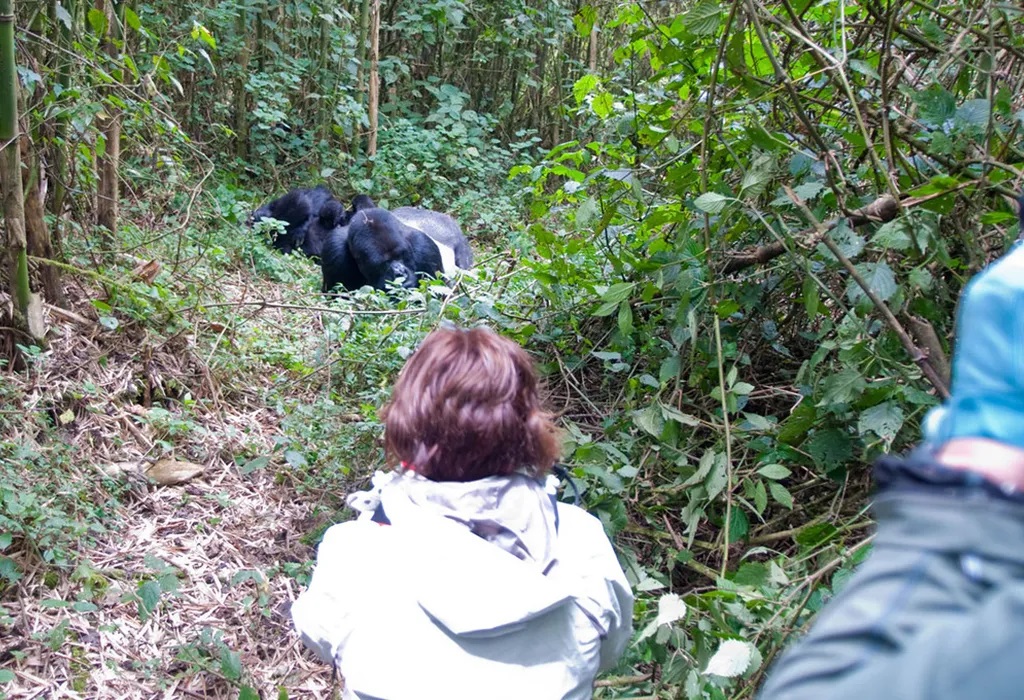
Imagine standing in a beautiful African rainforest, surrounded by thick vegetation and towering trees. Suddenly, your guide signals that a mountain gorilla family is nearby. As you move carefully through the forest, you notice a massive silverback resting among the greenery. A few metres away, a mother gorilla watches over her young while juveniles play around her.
This is the extraordinary experience that awaits visitors tracking mountain gorillas in Rwanda.
However, one important question often comes up when planning this adventure: How close can visitors actually get to mountain gorillas?
The answer is approximately seven metres under Rwanda’s published visitor guidelines. This distance helps protect gorillas from human diseases and unnecessary disturbance. Visitors must also follow their guides’ instructions throughout the encounter.
Gorilla tracking is not an ordinary wildlife viewing activity. It is a carefully managed conservation experience that allows visitors to observe endangered mountain gorillas in their natural habitat.
At Safari O’clock, we believe that understanding the rules before travelling makes the experience more enjoyable and responsible. Therefore, this guide explores how close you can get to mountain gorillas in Rwanda, why distance matters, what happens during the encounter and how to behave around these magnificent animals.
How Close Can You Get to Mountain Gorillas in Rwanda?
Visitors tracking mountain gorillas in Rwanda are required to maintain a distance of approximately seven metres (22 feet) from the animals, according to the Rwanda Development Board’s published tracking guidelines.
This rule applies during the gorilla viewing experience in Volcanoes National Park.
The distance helps reduce the risk of transmitting human diseases to gorillas. Mountain gorillas share many biological similarities with humans, making them vulnerable to certain respiratory infections and other illnesses.
Therefore, keeping a respectful distance is an important part of responsible gorilla tourism.
However, the seven-metre guideline does not mean visitors should approach the gorillas to measure the distance themselves. Your park guide will direct the group and explain how to behave throughout the encounter.
Sometimes, gorillas may move naturally through the forest and come closer to visitors. If this happens, remain calm and follow your guide’s instructions. Never attempt to touch, approach or follow a gorilla to obtain a closer photograph.
It is also important to understand that older conservation guidance has recommended greater distances, including ten metres. Therefore, visitors should follow the latest instructions provided by park authorities and their guides during the actual trek.
For Safari O’clock, the most important message is simple: enjoy the encounter without disturbing the gorillas.
Why Is There a Minimum Distance During Rwanda Gorilla Tracking?
Maintaining a safe distance is one of the most important rules of mountain gorilla conservation.
Although gorillas are habituated to the presence of humans, they remain wild animals. Habituation simply means that certain gorilla families have gradually become accustomed to controlled human observation.
It does not mean they are domesticated or immune to human-related risks.
There are several reasons why Rwanda maintains visitor distance requirements.
1. Protecting Gorillas from Human Diseases
Mountain gorillas are highly vulnerable to certain human illnesses.
Because humans and gorillas share many biological characteristics, some infections can pass between the two species. Respiratory illnesses are a particular concern.
Even an ordinary human cold can pose a serious health risk to a gorilla.
This is why visitors who feel unwell should not participate in gorilla tracking. Anyone experiencing symptoms of a contagious illness should inform their tour operator and follow the park’s health requirements.
Additionally, visitors must cover their mouths and turn away when coughing or sneezing.
Maintaining the recommended distance reduces opportunities for disease transmission. It therefore protects individual gorillas and entire families.
2. Preventing Unnecessary Disturbance
Mountain gorillas follow natural daily routines. They spend their time feeding, resting, grooming, moving through the forest and caring for their young.
Too much human interference can disrupt these activities.
Imagine a group of visitors constantly moving closer, making noise or attempting to photograph a gorilla from different angles. Such behaviour could create unnecessary stress.
The distance rule helps prevent this disturbance.
It allows visitors to observe gorillas while giving the animals enough space to continue their normal activities.
3. Protecting Visitors and Gorillas
Mountain gorillas are powerful wild animals. Although habituated families are accustomed to controlled human presence, they still deserve respect.
A silverback can display intimidating behaviour when it feels threatened or disturbed.
Keeping the recommended distance reduces the likelihood of uncomfortable encounters.
It also allows gorillas to move freely without feeling surrounded by visitors.
Safari O’clock encourages every traveller to remember that gorilla tracking takes place in the animals’ natural home. Visitors must respect that environment throughout the experience.
Where Can You Experience Close Gorilla Encounters in Rwanda?
Rwanda’s mountain gorilla tracking takes place in Volcanoes National Park, located in the northwestern part of the country.
The park forms part of the larger Virunga Conservation Area, which extends across Rwanda, Uganda and the Democratic Republic of the Congo.
Its landscape features volcanic mountains, bamboo forests, montane vegetation and dense rainforest.
The park provides a protected habitat for endangered mountain gorillas. It is also home to golden monkeys and several other wildlife species.
Visitors follow experienced guides and trackers into the forest to locate habituated gorilla families.
Once the trackers find the assigned family, visitors receive an opportunity to observe the animals for a maximum of one hour.
During this time, you may witness several fascinating behaviours.
A silverback may sit quietly while monitoring its surroundings. Mothers may carry their infants or allow them to play nearby. Younger gorillas may chase one another through the vegetation.
These natural interactions make the experience special.
However, the exact encounter depends on the gorilla family’s location and daily activities.
Safari O’clock recommends preparing for an authentic wildlife experience rather than expecting a staged photographic encounter.
What Happens When You Meet Mountain Gorillas in Rwanda?
The moment you encounter mountain gorillas is often the highlight of the entire safari.
After reaching the assigned family, your guide identifies a suitable observation position. The group then settles down and watches the gorillas quietly.
You may notice that different members of the family display different personalities and behaviours.
The silverback often plays an important leadership role. He may rest, feed or monitor the group’s surroundings.
Adult females usually spend considerable time feeding and caring for their young.
Young gorillas are often particularly entertaining. They may climb vegetation, play with one another or explore their surroundings.
Meanwhile, other family members may groom each other or move through the forest searching for food.
The experience offers an opportunity to observe gorilla behaviour in a natural setting.
However, visitors must remain quiet and avoid sudden movements. You should also never attempt to attract a gorilla’s attention.
Your guide will help position the group and explain the appropriate viewing procedures.
Remember, the objective is to observe the gorillas without interfering with their daily activities.
Can Mountain Gorillas Approach Visitors in Rwanda?
Yes. Although visitors must maintain the recommended distance, mountain gorillas sometimes move closer naturally.
This can happen when a gorilla walks through the forest, changes feeding locations or moves between family members.
For example, a curious juvenile may approach the general area where visitors are standing. An adult gorilla may also walk along a forest trail used by the tracking group.
These situations are part of observing wild animals in their natural environment.
However, visitors must never interpret a gorilla’s movement as an invitation to approach or interact with it.
If a gorilla comes closer than the recommended distance, remain calm. Do not reach out, attempt to touch it or make sudden movements.
Your guide will explain what to do and how to respond.
In some situations, the guide may instruct visitors to remain still, lower their gaze or move carefully.
Never attempt to create a closer encounter for photographs.
At Safari O’clock, we encourage travellers to prioritise responsible wildlife observation over getting the closest possible picture.
What Should You Do If a Gorilla Comes Too Close?
One of the concerns first-time visitors have is how to react when a mountain gorilla approaches them.
Although such encounters are generally managed by experienced guides, understanding the correct behaviour is important.
First, remain calm. Sudden movements, shouting or running can create unnecessary confusion.
Second, listen carefully to your guide. Park guides and trackers have experience observing gorilla behaviour and managing visitor encounters.
If instructed, remain still and avoid direct eye contact.
Do not attempt to touch the animal, even if it appears calm or curious.
Additionally, avoid blocking the gorilla’s movement. Allow it enough space to move naturally through the forest.
If a gorilla displays unusual behaviour, your guide will provide instructions on how to respond.
Remember that mountain gorillas are wild animals. Their behaviour can change depending on their surroundings, family interactions and perceived threats.
Therefore, visitors should never assume that a gorilla will behave in a predictable way.
How Long Can You Stay Close to Mountain Gorillas in Rwanda?
Rwanda allows visitors to spend a maximum of one hour observing their assigned habituated gorilla family.
The viewing period begins once the group reaches the gorillas.
This limit helps reduce disturbance and protects the animals from excessive human interaction.
During the hour, visitors have time to observe different family members and appreciate their behaviour.
You may watch a mother feeding her infant, a silverback resting or young gorillas playing.
Sometimes, the family may move through the forest during the viewing period. In such situations, visitors follow their guide’s instructions while maintaining the required distance.
Once the hour ends, the guide leads the group away from the gorillas.
The trekking journey itself can take much longer. Depending on the family’s location, visitors may walk for approximately 30 minutes or several hours before reaching the animals.
Therefore, the actual time spent hiking varies from one tracking experience to another.
How Many Visitors Can See a Gorilla Family at Once?
Rwanda limits the number of visitors who can track a habituated gorilla family.
Under the standard arrangement, a maximum of eight visitors can visit one gorilla family per day.
This restriction helps manage tourism activities and reduce pressure on the animals.
It also creates a more intimate wildlife experience because visitors do not have to share the encounter with large crowds.
Small groups make it easier for guides to communicate instructions and manage visitor behaviour.
Furthermore, limiting visitor numbers helps control the amount of human activity around each gorilla family.
For travellers, this means that securing a permit in advance is important.
Safari O’clock recommends booking early, particularly if you intend to travel during popular safari seasons.
Can You Touch Mountain Gorillas During Rwanda Gorilla Tracking?
No. Visitors must never attempt to touch mountain gorillas during a tracking experience.
Even when a gorilla appears relaxed, physical contact is not permitted.
Touching creates unnecessary risks for both visitors and animals.
For example, human illnesses can spread through close physical contact. Touching may also disturb a gorilla or cause it to react defensively.
It is important to remember that habituated gorillas are not pets.
They remain wild animals living in a protected forest environment.
Visitors should therefore observe them from the recommended distance without attempting to feed, touch or interact physically with them.
Even if a young gorilla approaches, do not reach out your hand.
Your guide will ensure that the group follows the appropriate conservation guidelines.
Can You Take Close-Up Photographs of Mountain Gorillas in Rwanda?
Photography is one of the most exciting parts of gorilla tracking.
Many travellers want to capture beautiful images of silverbacks, mothers and young gorillas during their forest encounter.
Fortunately, visitors can take photographs during the one-hour viewing period.
However, photography must follow the park’s conservation rules.
Flash photography is prohibited because sudden flashes can disturb the gorillas.
Visitors should also avoid moving closer to obtain better pictures.
Instead, use your camera’s optical zoom where possible. A camera with a good zoom lens can help capture detailed photographs without disturbing the animals.
A smartphone can also produce excellent photographs under suitable lighting conditions.
Keep your equipment ready before reaching the gorillas. This allows you to spend less time adjusting camera settings during the encounter.
Most importantly, listen to your guide and respect the required viewing distance.
Safari O’clock recommends capturing the experience naturally rather than focusing entirely on photography. Sometimes, the most memorable moments are those you simply observe without a camera.
What Are the Rules Visitors Must Follow Around Mountain Gorillas?
Rwanda has established strict visitor guidelines to protect mountain gorillas and maintain responsible tourism.
Before entering the forest, visitors receive a briefing from park officials.
The briefing explains the rules and expected behaviour during the encounter.
Some important guidelines include:
Maintain the recommended distance. Keep approximately seven metres between yourself and the gorillas, following the current instructions from park authorities and your guide.
Do not visit when sick. Visitors with colds, flu or other contagious illnesses should not participate.
Keep your voice low. Speak quietly when observing the gorillas.
Avoid sudden movements. Sudden movements may frighten or disturb the animals.
Never feed the gorillas. Human food is not part of their natural diet.
Do not touch the animals. Physical contact is prohibited.
Avoid flash photography. Use your camera without flash.
Do not litter. Carry all rubbish out of the forest.
Cover your mouth when coughing. Turn away from the gorillas and follow your guide’s instructions.
Respect the viewing time. Visitors can spend a maximum of one hour with the assigned family.
Following these rules helps protect mountain gorillas while creating a safe and meaningful experience for visitors.
Is Gorilla Tracking in Rwanda Safe for Visitors?
Gorilla tracking in Rwanda is a regulated tourism activity supported by trained guides, trackers and park rangers.
The experience takes place in Volcanoes National Park, where habituated gorilla families are monitored by conservation teams.
Before the trek, visitors receive instructions about safety and appropriate behaviour.
However, it is important to understand that gorillas remain wild animals.
Their behaviour cannot be controlled or guaranteed. Therefore, visitors must follow the guide’s instructions throughout the experience.
The forest environment also presents physical challenges. Trails may be steep, muddy or slippery, especially during rainy periods.
Visitors should wear appropriate hiking footwear and clothing.
A reasonable level of physical fitness also helps make the experience more comfortable.
For first-time travellers, having an experienced tour operator can simplify the arrangements.
Safari O’clock can help coordinate permits, transportation, accommodation and other safari requirements so that you arrive prepared for your gorilla tracking adventure.
What Should You Wear for a Rwanda Gorilla Tracking Experience?
The right clothing makes a significant difference when tracking mountain gorillas.
Volcanoes National Park has a cool mountain climate, and conditions can change quickly.
Rainfall can occur even when the morning begins with sunshine.
Therefore, visitors should prepare for both wet and relatively dry conditions.
Sturdy hiking boots are essential. Choose footwear with good grip and ankle support because forest trails can be uneven.
Long trousers and long-sleeved shirts help protect your skin against insects and stinging vegetation.
A lightweight waterproof jacket is useful when rain begins unexpectedly.
Gardening gloves can also protect your hands when holding vegetation for support.
Additionally, consider carrying a small backpack containing drinking water, personal medication, insect repellent and a waterproof camera bag.
Safari O’clock recommends choosing practical clothing that allows you to move comfortably through the forest.
When Is the Best Time to Experience Gorilla Tracking in Rwanda?
Rwanda offers gorilla tracking throughout the year.
Mountain gorillas remain in Volcanoes National Park during both rainy and relatively dry seasons.
However, weather conditions can influence the trekking experience.
The longer dry season usually occurs from June to September. Another relatively dry period generally falls between December and February.
During these months, trails may be less muddy, making walking more comfortable.
The rainy seasons generally occur from March to May and around October to November.
During these periods, rainfall can make the forest trails slippery. However, the landscape becomes especially green and beautiful.
Your preferred travel period will depend on your schedule, weather preferences and permit availability.
Regardless of the season, visitors should prepare for changing mountain weather.
Why Responsible Gorilla Tracking Matters in Rwanda
Gorilla tracking is more than an exciting wildlife experience. It plays an important role in protecting endangered mountain gorillas.
Rwanda has developed a conservation approach that connects tourism with wildlife protection and community development.
Tourism revenue helps support park management, conservation programmes and surrounding communities.
According to Visit Rwanda, 10% of national park tourism revenue is channelled into community development projects through the revenue-sharing programme.
These projects support important local needs, including schools, health facilities and infrastructure.
Tourism also creates employment for local people.
Trackers, rangers, guides, porters, drivers and hospitality workers all benefit from the gorilla tourism industry.
Consequently, responsible tourism helps create economic opportunities while strengthening support for wildlife conservation.
When visitors follow the distance rules, avoid disturbing animals and respect the forest, they contribute to protecting this important ecosystem.
At Safari O’clock, we believe that every gorilla tracking experience should support both wildlife conservation and the communities that live alongside these magnificent animals.
Experience Mountain Gorillas Responsibly with Safari O’clock
Getting close to mountain gorillas in Rwanda is an extraordinary wildlife experience.
However, the real beauty of gorilla tracking lies in observing these magnificent animals without disturbing their natural behaviour.
Visitors must maintain approximately seven metres of distance under Rwanda’s published guidelines. They must also follow their guides’ instructions, avoid physical contact and respect the one-hour viewing limit.
These measures protect gorillas from disease transmission and unnecessary human interference.
Whether you are watching a powerful silverback, a mother caring for her infant or young gorillas playing in the forest, every moment offers a deeper appreciation of these endangered primates.
If you are planning your first gorilla tracking adventure, proper preparation will help you enjoy the experience with confidence.
Safari O’clock is ready to help you organise your Rwanda gorilla safari, including permit arrangements, accommodation, transportation and other memorable wildlife experiences.
Contact Safari O’clock today and discover the magnificent mountain gorillas of Rwanda while contributing to their protection for future generations.